
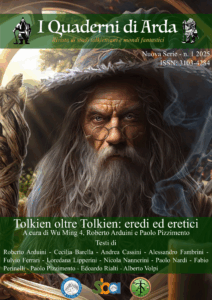
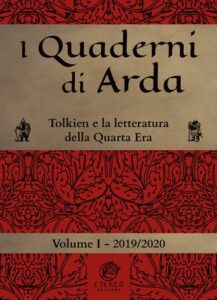
 A new issue of I Quaderni di Arda is published today, inaugurating a renewed editorial series and a new numbering. Beginning with this release, the journal becomes part of the University Library System of the University of Messina and aligns its scholarly production with the principles of open access, making its contents freely accessible and enhancing the dissemination of research. This event crowns a long journey that began twenty years ago with the founding of the Associazione Romana Studi Tolkieniani and the editorial series Tolkien e dintorni published by Edizioni Marietti, continuing with the birth of the Associazione Italiana Studi Tolkieniani, the establishment of the Tana del Drago in Dozza (Bologna), and the publication of the first four printed issues of I Quaderni di Arda (Eterea Edizioni), which featured proceedings of conferences organized at the University of Trento and the work of the AIST Study Group. The year 2025 marks a historic milestone: the founding of the first Italian academic journal dedicated to J.R.R. Tolkien.
The new series of I Quaderni di Arda opens with a monographic issue entitled Tolkien beyond Tolkien: Heirs and Heretics, edited by Wu Ming 4, Roberto Arduini, and Paolo Pizzimento. It is a programmatic beginning, an invitation to cross beyond the boundaries of canonical interpretation and explore the many trajectories of legacy, rewriting, and dissent born from Tolkien’s work.
Editorial
In recent years, the landscape of scholarly publishing has undergone a profound transformation, marked by a decisive shift away from print formats in favour of digital editions. For I Quaderni di Arda, a journal that aims to establish itself as a point of reference within the varied Italian panorama of Tolkien Studies, the decision to migrate from traditional print to digital form responds primarily to an ethical principle: making knowledge more accessible, rapid, and globally shareable, in keeping with the founding principles of the AIST (Associazione Italiana Studi Tolkieniani).
The partnership between AIST and the University of Messina — achieved through various shared initiatives and culminating in the inclusion of I Quaderni di Arda among the University’s academic journals — marks an important step towards increasingly rigorous scientific criteria and standards. Moreover, adopting an open access model will allow the articles published here to be freely available to both specialist and non-specialist audiences, ensuring wider circulation of research results and fostering collaboration among scholars worldwide.
From an editorial perspective, the transition entails significant restructuring in the management of peer-review and editing processes, and in the preservation and indexing of content. Furthermore, through Creative Commons licensing, it safeguards authors’ rights while encouraging the reuse of their publications for scholarly and educational purposes.
Symbolically, the move to open access expresses the commitment of AIST, together with the University of Messina, to pursue a science that is more transparent, inclusive, and sustainable, in line with the principles of Open Science promoted internationally.
The articles inaugurating this new era of I Quaderni di Arda compose an inevitably partial inquiry into the influence that Tolkien’s work has had on major writers of the fantastic genre who followed him and who now stand at the threshold of the twenty-first century. The case studies encompass at least three generations: those born around the 1930s, those born after the Second World War, and those born in the 1960s and 1970s. Certainly, many names are missing — a complete survey would have required a vast, almost encyclopedic undertaking — yet the selection here offers a rich and meaningful sample of markedly diverse approaches and perspectives. With one common denominator: every author considered acknowledges a debt to Tolkien. And this is true even — and perhaps especially — in the case of those writers who felt the need to distance themselves from, and harshly criticize, Tolkienian fantasy, such as the “heretics” Moorcock, Morgan, Miéville, and Abercrombie. Gentler in tone are Le Guin, King, Gaiman, and Liu, who pay homage to the master yet also seek their own path without falling into the error of imitation, becoming thus Tolkien’s finest “heirs.”
This sequence of essays powerfully demonstrates not only how deeply Tolkien influenced the work — and earlier still the literary vocation — of later authors in the fantastic genre, but also how crucial their voices have become within contemporary literary criticism.
When Michael Moorcock wrote his celebrated Epic Pooh (1978), he composed a kind of political manifesto against the fathers of British fantasy; yet it was above all through his immense narrative production that he sought to de-ideologize bourgeois, Christian-conservative fantasy, carrying it into the culture of the 1960s-70s.
Similarly, China Miéville certainly addressed the theme of “killing the oedipal father,” but did so while incorporating into his own world-building everything that Tolkien had left outside his, above all class conflict. In Miéville’s fiction, disharmony does not arise from some alien force embodied by a villain, but rather from contradictions internal to society.
 When Richard K. Morgan determined that his fiction would take an entirely different direction from the author he had cherished in youth — toward a crossover of fantasy, science fiction, and hard-boiled — he did not forget to use Tolkien’s example for motivation, particularly the Orcs. In Tolkien’s Orc dialogues, Morgan argues, one senses an entire society, a world, full of aspirations, contradictions, fears — which Tolkien does not explore, because doing so would endanger the worldview sustaining his world-building, introducing an ethically complex element difficult to manage within the established framework, a framework that reserves no pity for Orcs. It is no coincidence, one may add, that the Orcs remained one of Tolkien’s unresolved problems, a potential fissure in the architecture of Arda.
Moreover, in one of Morgan’s narrative cycles, the Bay City cycle, a kind of reincarnation becomes possible — the transfer of personality from one body to another through a transferable memory stack. This reincarnation is reserved not to a chosen race but to a superior social class, destined to live forever in the world, like Tolkien’s Elves or perhaps like his Ringwraiths.
In Joe Abercrombie’s First Law universe we find inverted versions of many characters from The Lord of the Rings: beginning with the wizard Bayaz, Gandalf’s alter ego — or rather a fusion of Gandalf and Saruman — combining charisma, cynicism, and the will to power for benevolent ends, collapsing distinctions that Tolkien had carefully maintained.
Likewise, in the silkpunk world-building of Sino-American writer Ken Liu, good and evil are blurred, ambiguous, difficult to identify, rarely embodied in morally consistent individuals, and more often locked in irreconcilable conflict, without hope of redemption. Once again grimdark atmospheres prevail, reflecting a hyper-contemporary sensitivity increasingly reluctant to believe in the good, and therefore in the possibility of choosing it infallibly.
Neil Gaiman explicitly states that he decided to write fiction after reading Tolkien, yet he did not follow Tolkien’s example: instead of creating a finished secondary world entirely separate from our own, he imagined the coexistence of multiple worlds, with unpredictable points of access destabilizing our singular perception of reality.
Stephen King admits that he understood early on that following in the footsteps of the oedipal father made no sense, that repeating what Tolkien had already done would mean condemning oneself to imitation, and that instead Tolkien’s stories should be treasured by reusing their finest ingredients. Much like Ursula K. Le Guin, who built the world of Earthsea and was among the first to emphasize Tolkien’s work on language and its importance for depth and verisimilitude.
And naturally George R.R. Martin could not be absent: long before A Song of Ice and Fire, he produced with Armageddon Rag (1983) his true great homage to Tolkien and to the American counterculture of the 1960s, which embraced him as a cult author. Martin adopts Tolkienian themes — above all the perilous allure of nostalgia — creating a novel set in post-counterculture America of the 1980s that is both a classic hero’s journey and a detective story, suspended between realism and psychedelic vision.
Finally, Antonia Byatt, who is not an author of fantasy literature, inserted many Tolkienian references into her realist novels — opening yet another line of inquiry, one perhaps to pursue in the future: Tolkien’s influence on non-fantasy fiction. Certainly such an inquiry would be more difficult and its results uncertain, but no less interesting for that.
A step in this direction is already represented by the parallel between Tolkien and the recently deceased Francesco Benozzo, who shared with the Oxford professor not only scholarship and teaching in philology (in Benozzo’s case at the University of Bologna), but also and above all the rewriting and reinvention of cosmogonic myths. Benozzo sought with great originality the path of “re-enchantment” through poems uniting scientific thought and poetry — contemporary conceptions of matter and the necessity of the marvelous and the epic.
The issue concludes with three reviews
Pity, Power and Tolkien’s RIng: To Rule the Fate of Many by Thomas P. Hillman (2023), a study on the importance of pity and grace in the Ring cycle, where the former reaches only a certain point before being completed by the latter — namely, by providential action.
Tolkien and the Mystery of Literary Creation by Giuseppe Pezzini (2025), a wide-ranging and articulate dissertation on Tolkien’s poetics and his literary theory expressed both in essays and in fiction. It is a work that truly establishes the academic state of the question and — despite some limits highlighted in the review — aspires to become a major reference for scholars of these themes.
Last comes the review of The Collected Poems of J.R.R. Tolkien, edited by Wayne G. Hammond and Christina Scull (2024), three substantial volumes presenting the majority of Tolkien’s poetic work with an extensive apparatus of historical-biographical annotation, as is customary with the two American scholars.
Enjoy your reading.
Per la versione Italiana di questo articolo vedi qui.
Contents of this issue
- Wu Ming 4, Roberto Arduini, Paolo Pizzimento, Editoriale
- Focus
- Roberto Arduini, Armageddon Rag: l’eredità tolkieniana in un contesto moderno
- Cecilia Barella, J.R.R. Tolkien e A.S. Byatt: connessioni
- Andrea Cassini, «E alcune cose, che non avrebbero dovuto essere dimenticate, andarono perdute»: Ken Liu e Tolkien fra eredità, modernità e tradizione
- Alessandro Fambrini, Cattivi scrittori con grandi idee: Moorcock, Tolkien e le rivoluzioni possibili
- Fulvio Ferrari, J.R.R. Tolkien e China Miéville: l’uccisione del padre e la creazione dei mondi
- Loredana Lipperini, J.R.R. Tolkien e Stephen King: una lunga storia
- Paolo Nardi, Tra mito e soglia: Tolkien e Gaiman a confronto
- Fabio Perinelli, Gritty Fantasy. La Prima Legge a confronto con il legendarium tolkieniano
- Edoardo Rialti, Oscurità desiderata allo specchio: R.K. Morgan e J.R.R. Tolkien
- Alberto Volpi, Magia, donne e draghi: continuità e variazioni del modello tolkieniano in Earthsea di Ursula K. Le Guin
- Extra
- Recensioni
- Nicola Nannerini, Recensione a Thomas P. Hillman, Pity, Power, and Tolkien’s Ring. To Rule the Fate of Many
- Nicola Nannerini, Recensione a Giuseppe Pezzini, Tolkien and the Mystery of Literary Creation
- Paolo Pizzimento, Recensione a Christina Scull, Wayne G. Hammond (eds.), The Collected Poems of J.R.R. Tolkien
Linked Articles:
– News: I Quaderni di Arda is born: a Journal of Tolkien Studies
.