
Tolkien Ludens: Narrative, Myth, and Play in Middle-earth
Edited by Nicola Nannerini and Paolo Pizzimento
Clicca qui per la versione italiana
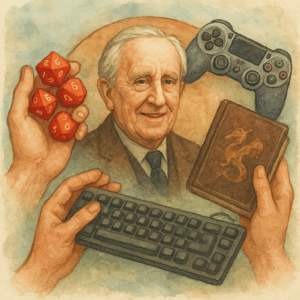 Over the past two decades, scholarship has shown that Tolkien’s Secondary World is not only a literary artefact but also an exemplary laboratory for the construction of transmedial worlds, in which narrative logic, system design, and player practices converge across video games, board and card games, LARPs, and online platforms. Drawing on consolidated theoretical frameworks in transmediality and imaginary-world studies, I Quaderni di Arda seeks to investigate the multifaceted galaxy of Tolkienian games and the relationship—at times direct, at times dialectical—that they establish between narrative fidelity and design transformation. It also aims to reflect on how interactive systems negotiate canonicity, expectations, and audience participation (Wolf 2018; Freeman and Gambarato 2019).
 Accordingly, this Call for Papers aims to advance role-playing game studies by foregrounding kinships and identity work in online communities, the ethics of action and the dynamics of dark play surrounding antagonists and antiheroes, as well as the procedural articulation of moral choice—topics that the literature has already explored in MMORPGs, LARPs, and computer role-playing games from a variety of disciplinary perspectives (Zagal and Deterding 2018; Mortensen, Linderoth and Brown 2015). At the same time, it seeks to devote particular attention to the material, regulatory, and paratextual conditions of play—such as mods, expansions, scenario design, and component ecologies—that shape reception and reinterpretation, including in board and card games (Brown, MacCallum-Stewart and Wilhelm 2020; Björk and Holopainen 2005). By combining transmedial character studies with worldbuilding scholarship, I Quaderni di Arda invites analyses of, for instance, how secondary figures, factions, and landscapes become playable interfaces of Arda’s mythic grammar; how exploration and immersion are designed in The Lord of the Rings Online (LOTRO) and related role-playing games; and how strategy titles operationalize power, warfare, and space (Kunz and Wilde 2023; Wolf 2020).
 As an unprecedented initiative in Italy, this thematic inquiry seeks to explore the ludic and transmedial world of the Legendarium and to outline a research programme that considers Tolkienian games as sites in which subcreation is collectively enacted, discussed, and extended (Wolf 2018; Freeman and Gambarato 2019; Björk and Holopainen 2005).
I Quaderni di Arda therefore welcomes proposals that explore (though are not limited to) the following research areas:
-
The Lord of the Rings as interactive myth: analysing narrative fidelity and transformation in video games set in Middle-earth;
-
Company or factions: the formation of kinships in Tolkienian MMORPGs and their social dynamics;
-
The ethics of heroism: exploring moral choices in Middle-earth: Shadow of Mordor;
-
The Tolkien transmedial ecosystem: the role of paratexts in shaping expectations for Middle-earth video games;
-
Virtual exploration of Middle-earth: cognitive and emotional immersion in The Lord of the Rings Online;
-
The Battle for Middle-earth: interpreting war and power in Tolkien-inspired strategy games;
-
Paratextual play: the impact of player-created mods on the interpretation of Tolkien’s mythology in video games;
-
Middle-earth in our hands: adapting Tolkienian tradition in tabletop role-playing games;
-
The Hobbit’s journey: designing and adapting adventure games in the Tolkienian universe;
-
The psychology of fantasy: motivations and identities of players in Tolkien-themed LARPs;
-
Fantasy card games and Tolkien’s world: narrative and interaction in The Lord of the Rings: The Card Game;
-
Reimagining the enemy: the role of antagonists and antiheroes in the Middle-earth video-game franchise;
-
Beyond the Ring: the psychological appeal of Tolkien’s secondary characters in role-playing games;
-
Exploring digital Middle-earth: comparing narrative strategies in single-player and multiplayer games;
-
The role of exploration in Tolkienian interactive landscapes: mapping immersion in Middle-earth role-playing games.
Submissions may be sent in Italian or English, complete and prepared according to the editorial guidelines of I Quaderni di Arda, to the following email addresses: nicola.nannerini@gmail.com and paolo.pizzimento@unime.it. Proposals must be submitted no later than 31 May 2026. Acceptance will be communicated to authors via email by 30 June 2026.
Volume no. 2 (2026) of I Quaderni di Arda will be published by December 2026.
Works cited
Björk, Staffan, Holopainen, Jussi 2005. Patterns in Game Design. Hingham, MA: Charles River Media.
Brown, Ashley M.L. 2015. Sexuality in Role-Playing Games. New York: Routledge.
Brown, Douglas, MacCallum-Stewart, Esther, Wilhelm, Matthew (eds.) 2020. Rerolling Boardgames: Essays on Themes, Systems, Experiences. Jefferson, NC: McFarland.
Freeman, Matthew, Rampazzo Gambarato, Renira (eds.) 2019. The Routledge Companion to Transmedia Studies. New York: Routledge.
Kunz, Tobias, Wilde, Lukas R. A. 2023. Transmedia Character Studies. Abingdon, Oxon, and New York: Routledge.
Mortensen, Torill E., Linderoth, Jonas, Brown, Ashely M.L. (eds.) 2015. The Dark Side of Game Play: Controversial Issues in Playful Environments. New York: Routledge.
Wolf, Mark J.P. (ed.) 2018. The Routledge Companion to Imaginary Worlds. New York: Routledge.
Wolf, Mark J.P. (ed.) 2020. World-Builders on World-Building: An Exploration of Subcreation. New York: Routledge.
Zagal, José P., Deterding, Sebastian (eds.) 2018. Role-Playing Game Studies: Transmedia Foundations. New York: Routledge.
Zagal, José P., Deterding, Sebastian (eds.) 2024. The Routledge Handbook of Role-Playing Game Studies. New York: Routledge.
Linked Articles:
– News: New Issue and editorial format for «I Quaderni di Arda»
– News: I Quaderni di Arda is born: a Journal of Tolkien Studies
.